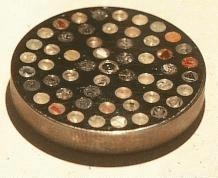
SPI Supplies® Brand Microanalysis Standards
Choose from two different approaches to the purchase of standards including
the library of standards created by Charles M. Taylor.
Introduction:
High quality Standards for Microanalysis are mandatory for any laboratory
with EDS or WDS wanting to make certain of the calibration of their
instrumentation. What used to be optional today is mandatory because of the
proliferation of accreditation programs, and the demands of users of
microanalysis laboratories to provide documentation that their equipment is
operating according to instrumental specifications.
What is "quality" in a microanalysis standard?
This is often times thought to be, at least to some degree, "in the eyes of
the beholder". However, it is generally recognized that a high quality set
of standards must have not only good documentation and traceability of the
standard materials being used, but they should be easy to use at the same
time. The SPI Standards for Microanalysis have the highest homogeneity ever
found in such standards and in addition, SPI gives the customer the chance
to select between creating their own unique custom standard or as an
alternative, selecting from one of a number of off-the-shelf standard
products.
Minimum Size of the Standard Materials:
There is quite a variation between the largest and the smallest of the
standard materials. In general, the standard items
from the Charles M. Taylor standards collection are larger by perhaps 2X
than the same standards that might be found in
the SPI collection. Whereas the largest standards in the Taylor collection
might be as large as 2 mm, for the SPI
collection, that largest size is about 1 mm. Some of the minerals
especially in the SPI collection, could be in individual
grains substantially less then 1 mm, but a number of individual grains
would always be found for each mineral. During a
nearly twenty five year time frame that these standards have been offered,
not a single customer has ever been unhappy
about the minimum size of the individual grains.
Unique "standard" features:
Remember that the SPI Supplies Standards for Microanalysis are designed,
produced and tested by professional experts
who have had years of "hands-on" experience actually using such standards.
No one knows more what an analyst needs
than another analyst! That is why we know how valuable the electron beam
labeling, right on the mount, can be to
someone not sure which standard item they are irradiating. And while we
know that all modern instruments have built-in
Faraday cups by the manufacturer, we also know that there are enough
instances when that built-in capability is not
working, so that is why a Faraday cup is automatically built in to each and
every SPI manufactured standard for
microanalysis. Less experienced people might not appreciate that benefit of
an extra Faraday cup, but any experienced
user would!
Coating vs. No Coating
Electron beam microanalysis requires that there be a conducting path to ground from the point of beam
impact on the standard surface. For standards of non conductive materials, such as
oxides, silicates and, indeed, most minerals, this can only be achieved by vacuum deposition of a thin film
of a conducting substance like carbon or gold onto the polished surface of the mount.
Carbon is the material most often used as it is inexpensive,
easy to evaporate and most X-rays emitted from the surface are only weakly absorbed.
In the case of a standard block which contains only
conducting substances such as metallic elements or alloys,
the electrical path to ground can be provided through, rather than across,
the embedding medium, since there is no longer a problem of conduction
from the point of impact of the beam to the edge of the grain.
Impregnation of the mounting plastic with copper powder accomplishes this.
Hence for special applications or by special request, we can
provide standards uncoated, using a conductive plastic. However,
all the standards in such a mount must themselves be metallic, and it
should also be noted that our unique electron beam lettering (mentioned below and
illustrated widely on these pages, e.g.
Cassiterite) cannot be applied to conductive plastic.
Design-Your-Own Standard (DYOS):
For the most demanding of researchers, often times a "one-size-fits-all" off the shelf standard is just not an option. And therefore, SPI Supplies offers researchers the chance of designing their own standard, and being able to select from two famous libraries, the Charles M. Taylor library of standards and the SPI Supplies library of standards that have been used in the SPI Supplies "off-the-shelf" standards for more than twenty years. The documentation which goes with each DYOS can be seen in a typical DYOS User's Manual which has, in addition to the chemical composition and origin, a photograph and plan of the mount showing details of each position, and a photomicrograph and X-ray emission spectrum of each item in your custom mount.
Off-The-Shelf Standards (OTSS):
The ready-made "Off-The-Shelf" standards from SPI Supplies are made in large production quantities, thereby making complex standards available at significantly lower prices than would be possible with the one-of-a-kind "Design-Your-Own" Standard. These are the standards that have been sold to literally hundreds of users all over the world. They are especially prized by those teaching courses in microscopy and microanalysis to students. They are also valuable for those in a central kind of facility not knowing for sure what kind of sample might present itself one day to the next. And the standard "off-the-shelf" products are economically priced as well. The documentation which accompanies each of these standards contains photographs for each item in addition to X-ray spectra and details of the chemical compositions of the batch from which the grains were taken. The provenance of the standard and maintenance instructions are also given. Take a look at one such spiffy manual.
Documentation:
SPI Supplies sets the world's standard for documentation provided with each
standard mount for microanalysis, as mentioned above. Individual manuals are maintained by SPI Supplies in pdf format and can be emailed to a purchaser at any time after the standard has been acquired.
Storage of standards for microanalysis:
Because of the highly polished nature of all of the standard items, as well
as the inherent reactivity of some of the standard items, in order to
protect your investment in a valuable standard, we recommend it be stored
either dry in a desiccating cabinet or in the case of oxygen sensitive
items, in one of our SPI-Dry™ Sample Preserver Capsules.
The "secret benefit" of using SPI Supplies standards:
SPI Supplies developed some years ago the ability to label
with an electron beam the description of each standard item right in the plastic embedding resin.
Hence, the user is never really "in the dark" in terms of knowing precisely
what standard feature they are analyzing. We are unaware of anyone who has
ever worked with an SPI standard that featured the electron beam lettering
and could ever return to one of the more primitive standards available from
other sources but without such lettering!
So whether you are looking to create your own "custom"
Design-Your-Own Standard (DYOS) or you are looking for a grand collection of the most commonly
needed standards, and would prefer an
"off-the-shelf" unit, be sure to think first of SPI Supplies. You
certainly can find cheaper standards (as well as more expensive ones), but
you can not find standards of a higher quality or standards that have this
kind of unique electron beam lettering. And you can carefully
"Design-Your-Own-Standard" (DYOS) taking advantage of the well-characterized
standards from the Charles M. Taylor library
of standards recognized worldwide for their quality.
For other EDS performance measuring products, consider the
X-Checker EDS Performance Checker Mounts.
Remember also that in many instances,
the use of standards for microanalysis is useful for measuring the detection
limits and performance of your backscattered electron detector.
Refurbishing the standards:
We guarantee to all customers of the SPI Supplies brand of standards for
microanalysis access to our unique yet still economical standards
refurbishing service.

To Ask a Question or Make a Comment
To Place an Order or Request a Quote
Return to:
Monday March 22, 2010
© Copyright 1996 - 2010. By Structure Probe, Inc.
Contacting SPI Supplies and Structure Probe, Inc.
All rights reserved.
All trademarks and trade names are the property of their respective owners.
Worldwide Distributors, Representatives, and Agents